How to solve Math Kangaroo problems: 9 strategies and free practice tests
Math Kangaroo (Kangourou sans Frontières) is an international multiple-choice math contest held every March, written by students in dozens of countries. Its problems look short and friendly, but most of them hide a trick: the usual school method is slow, and one good idea solves them in a minute. The good news is that the same ideas come back every year. Below are the nine kinds of problems that make up most of a paper, each with an example of our own, how to solve it, and a printable worksheet to practise.
sowa.study isn't connected with the contest or its organisers. All examples and worksheets here are our own; for past papers, see your country's official contest website.
How the test works
- Papers are written for pairs of grades (3–4, 5–6, 7–8 and up), with an easier one for the youngest.
- The questions come in three sections worth 3, 4 and 5 points, harder as they go: from 21 questions for the youngest to 30 for the older levels.
- Every question has five answers, A to E, and exactly one is right.
- The test takes 75 minutes, and calculators aren't allowed.
- Scoring differs between countries: in some, a wrong answer costs part of the question's points, while a blank costs nothing. Check your country's rules before the test, because they decide whether guessing pays.
1. Read the question to the last word
Many wrong answers come from answering a different question: the number of children instead of the number of hands, “how many” instead of “how many more”, the day before instead of the day after. The wrong options are picked to match exactly these slips. Before solving, ask your child to say in their own words what is asked, and to circle the key word: more, at least, at most, not.
Example: Eight children stand in a row. Tom is third from the left. How many children stand to his right? Not 3 and not 6: two children stand to his left, so 8 − 3 = 5.
Practise with Contest Word Problems: Grades 1–2 and Grades 3–4.
2. Work backwards
When a problem tells you what happened and how it ended, start from the end and undo each step.
Example: Lily thinks of a number. She doubles it, adds 6 and gets 20. What was her number? Undo the steps in reverse order: 20 − 6 = 14, then 14 ÷ 2 = 7.
3. Let the answers help
Five options are a hint. Often it's quicker to check them than to solve the problem: put each one into it. Even when your child can't solve a problem, they can often rule out two or three options that are too big, odd when the answer must be even, or not divisible as needed.
Example: Three consecutive numbers add up to 48. What is the largest? A) 15 B) 16 C) 17 D) 18 E) 19. The middle one is 48 ÷ 3 = 16, so the largest is 17. Checking the options gets there too: 15 + 16 + 17 = 48. Older students find many problems like this in Contest Word Problems: Grades 7–8.
4. Balance scales: take the same from both pans
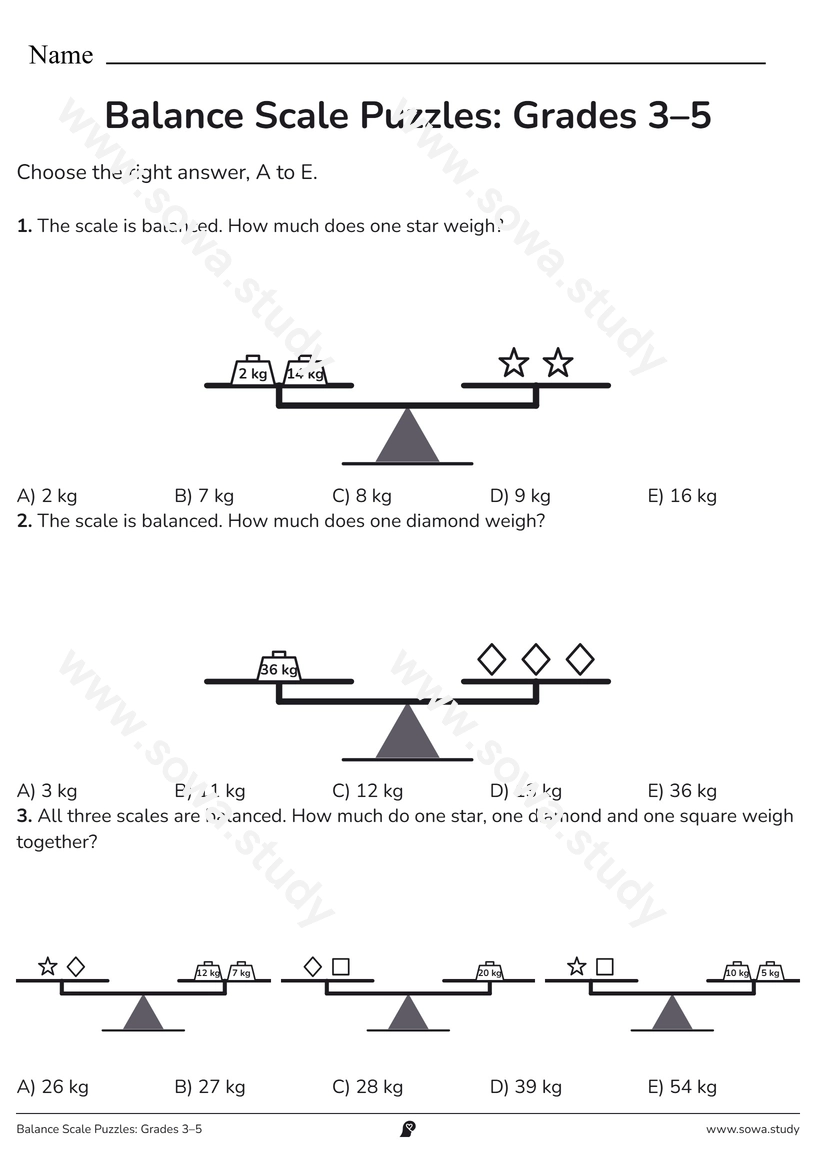
A balanced scale stays balanced when the same thing comes off both pans. Compare two scales and look at what's different.
Example: Two circles and a square weigh 10 kg. One circle and a square weigh 7 kg. Take a circle and a square off the first scale: one circle weighs 10 − 7 = 3 kg, so the square weighs 7 − 3 = 4 kg.
“Which is the heaviest?” works the same way: if a circle balances two triangles, the circle is heavier than a triangle. Practise with Balance Scale Puzzles: Grades 1–2 and Grades 3–5.
5. Cube buildings: count column by column
Counting the cubes in a drawing goes wrong easily, because some are hidden. Count in columns instead: write how many cubes stand on each square of the floor (a plan), then add the numbers up. The hidden cubes are the ones under the tops you can see.
Example: A building stands on a 2 × 2 floor, with columns of 3, 2, 1 and 2 cubes. That's 3 + 2 + 1 + 2 = 8 cubes. How many more make it a 2 × 2 × 3 block? The block has 12, so 4.
Build a few of these with real blocks first: seeing the hidden cubes once helps a lot. Then try Cube Buildings: Grades 2–4 and Grades 5–8.
6. Turning and mirroring: follow one detail
Don't compare whole pictures. Pick one detail, such as a dot in a corner or a short line, and follow only that. A quarter turn clockwise takes the top-left corner to the top right, and the top right to the bottom right. A mirror swaps left and right but keeps top and bottom. Any option with the detail in the wrong place is out.
Tracing paper is a good helper at home: draw, turn, flip and look. Practise with Turn, Mirror and Fold: Grades 2–4.
7. Number puzzles: count what's counted twice
When numbers go into circles or squares, don't place them at random. Start where the rules are tightest, or look for numbers that are counted twice.
Example: Put 1, 2, 3, 4, 5 and 6 in the six circles of a triangle (three corners and three middles) so that every side adds up to 10. Which numbers go in the corners? The three sides together make 30, but 1 + 2 + … + 6 is only 21. The extra 9 comes from the corners, as each of them is on two sides. The only corners that work are 1, 3 and 5: 1 + 6 + 3, 3 + 2 + 5 and 5 + 4 + 1.
Practise with Number Puzzles: Grades 3–5 and Grades 6–8.
8. Logic: try every case
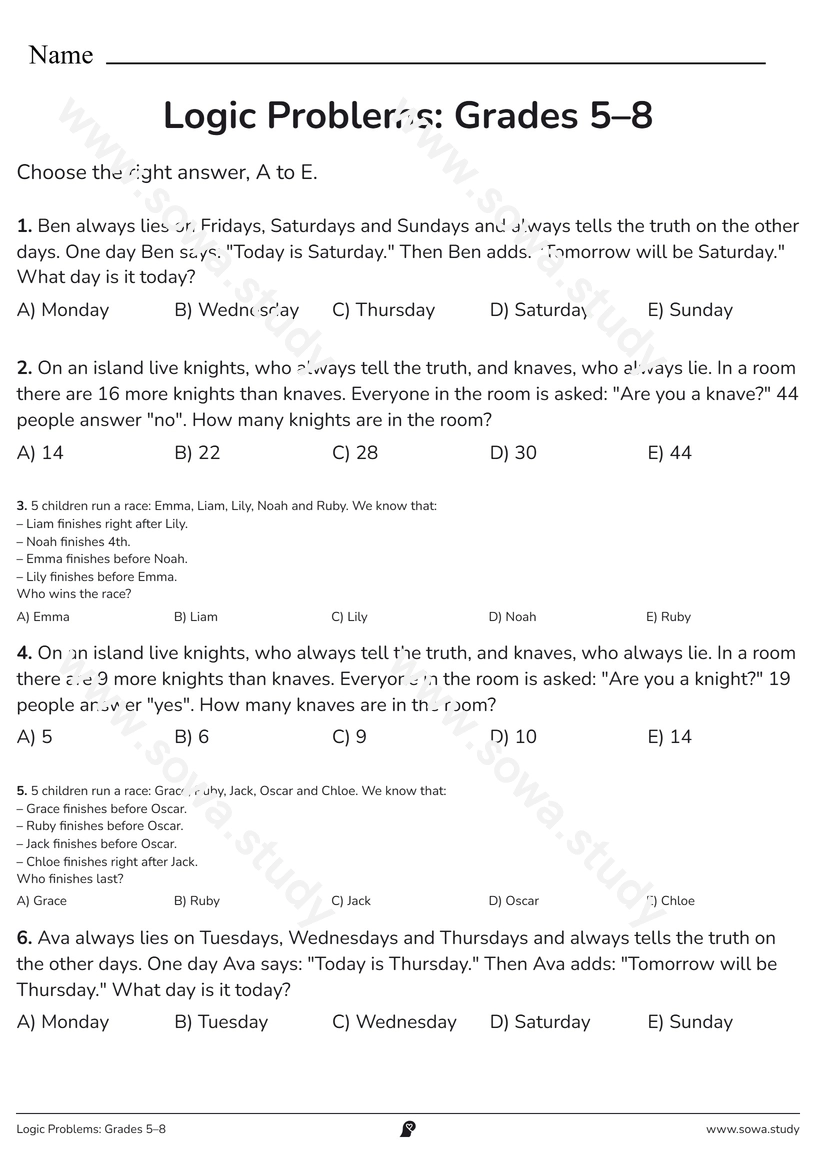
“Who is lying?” and “who has which pet?” are solved by trying each possibility and crossing out the ones that break a rule. A small table keeps everything in sight.
Example: Someone broke a vase. Anna says: “Ben did it.” Ben says: “I didn't.” Cleo says: “I didn't.” Only one of them tells the truth. Who broke the vase? Anna and Ben say opposite things, so exactly one of them tells the truth. That means Cleo is lying: Cleo broke the vase. Check it: Anna lies, Ben tells the truth and Cleo lies, so there's one truth.
The youngest start with picture puzzles, older students get liars and days of the week. Try Picture Logic Puzzles: Grades 1–2 and Logic Problems: Grades 5–8.
9. Geometry: look for what stays the same
Contest geometry rarely needs long calculations. Look for what doesn't change: moving a piece keeps the area, and pushing an edge in or out of a right-angled shape can keep the perimeter.
Example: A 3 cm square is cut from each corner of a 10 cm square sheet. What is the perimeter of the cross that is left? Each cut takes 3 cm off two edges and adds two new 3 cm edges, so the perimeter stays 40 cm. The area does change: 100 − 4 × 9 = 64 cm².
The same idea works for a staircase shape with right-angled corners: its perimeter is the same as the rectangle around it. Practise with Geometry Contest Problems: Grades 5–8. For younger children, Grid Puzzles: Grades 2–4 has paths, rugs and pieces on squared paper.
On the day of the test
- 75 minutes for 30 questions is 2.5 minutes each, and the 5-point questions need more. Do the first section quickly but carefully: its points are the easiest.
- Stuck for more than three minutes? Mark the question, move on and come back at the end.
- If a wrong answer costs a quarter of its points, a blind guess gains nothing on average, but a guess after ruling out even one option pays. If wrong answers cost nothing, never leave a blank.
- Draw on the question sheet: sketches, tables, a plan of the cubes. The answer card only takes letters.
- Fill in the answer card as you go, not at the end, and check that the question numbers match.
How to practise with our worksheets
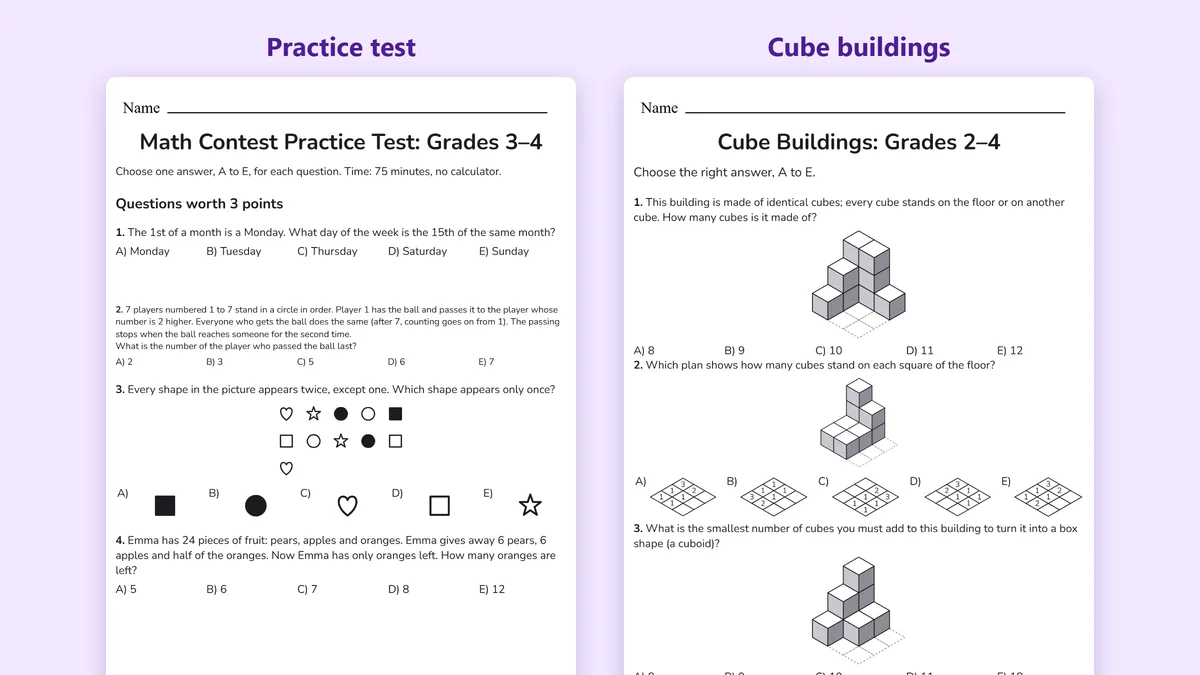
Our practice tests follow the contest's format: the same number of questions per level in 3-, 4- and 5-point sections, options A to E and an answer card at the end. Every print is a new test with new numbers, so one worksheet lasts the whole season, and the answer key is one switch away on the worksheet page.
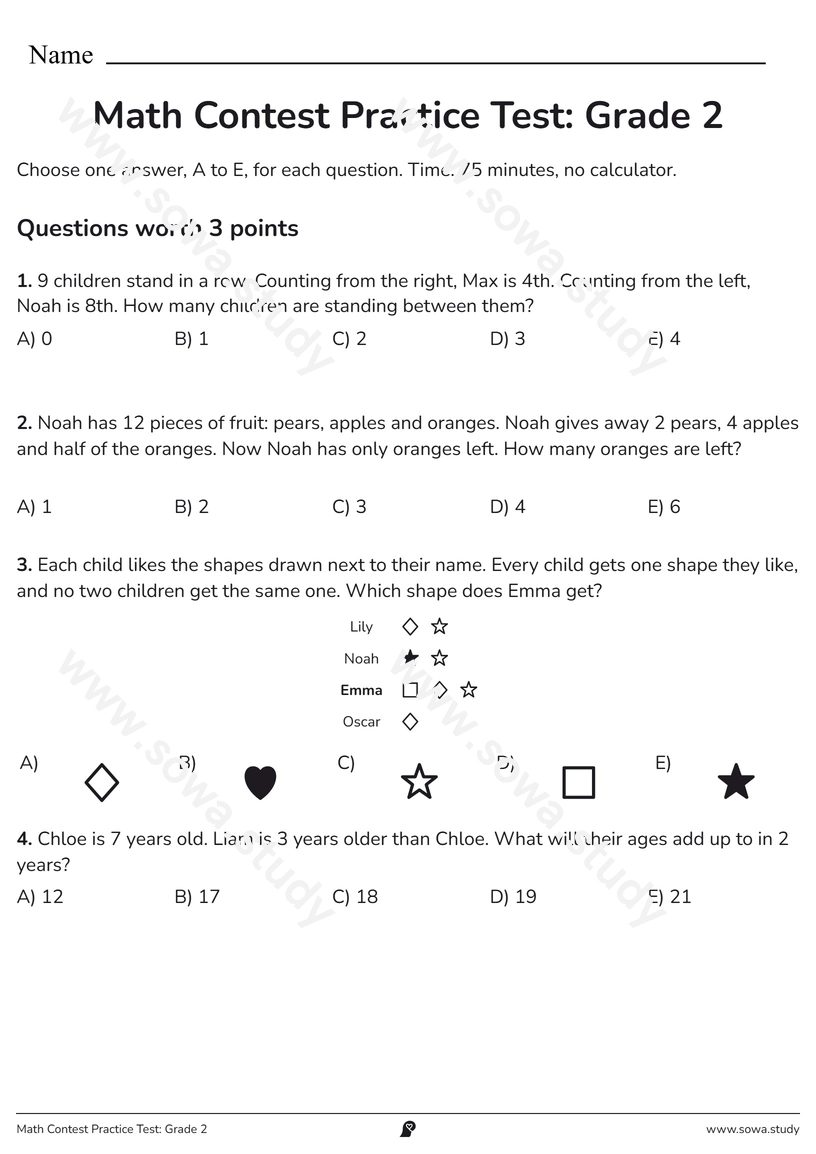
- Practice test: grade 2 (21 questions)
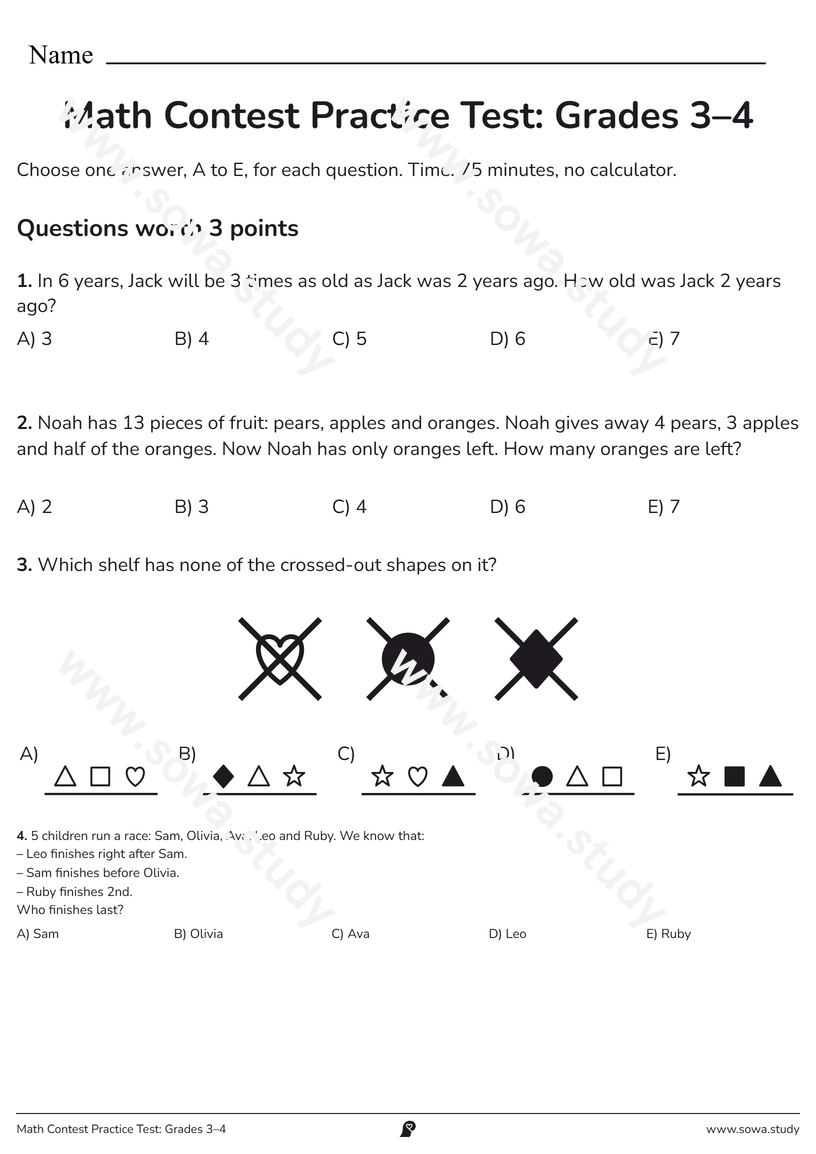
- Practice test: grades 3–4 (24 questions)
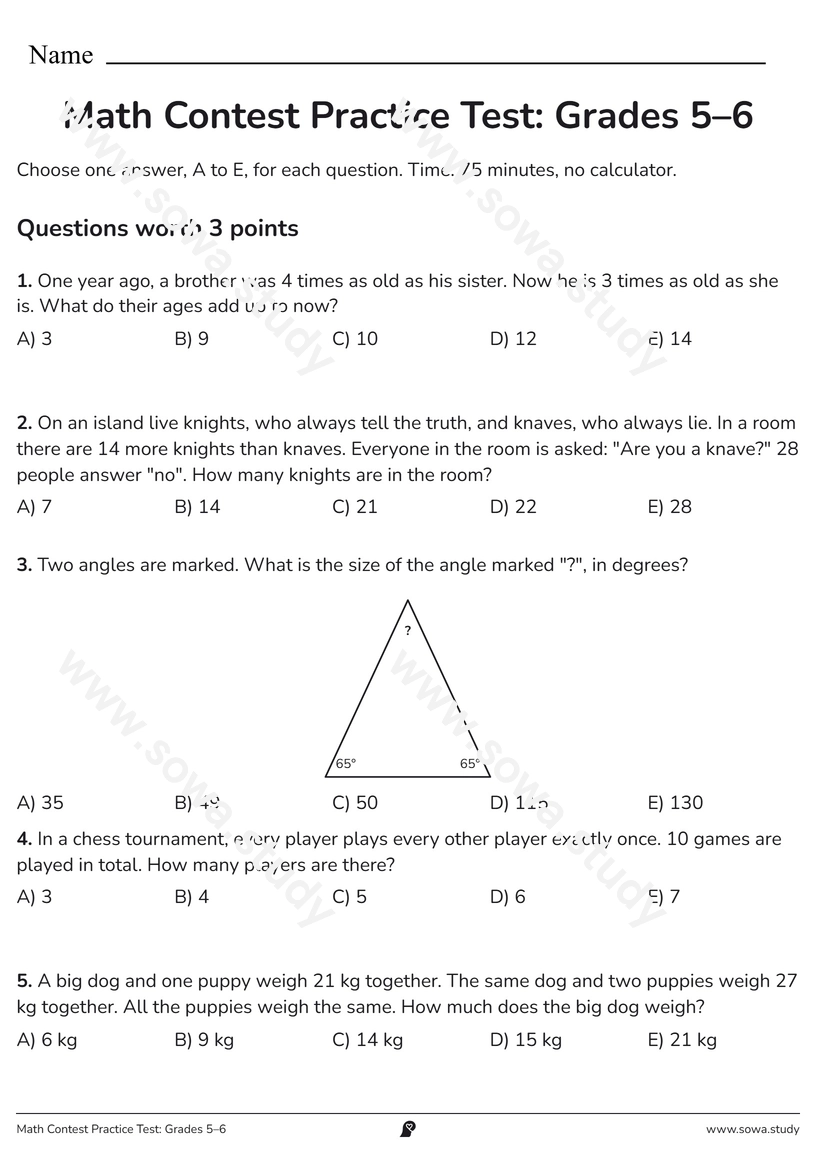
- Practice test: grades 5–6 (30 questions)
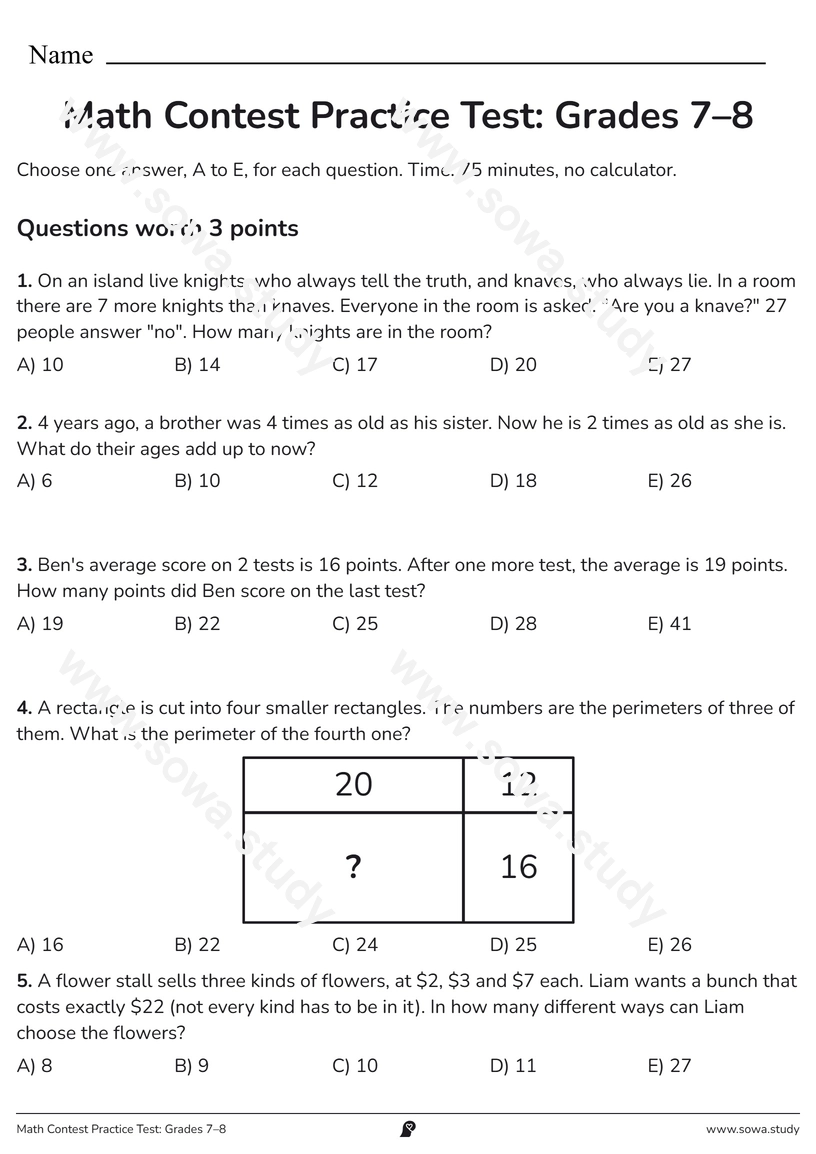
- Practice test: grades 7–8 (30 questions)
A good plan: from January, one topic sheet a week, starting with the kind your child gets wrong most. Every two or three weeks, a whole test with a 75-minute timer. Afterwards, go through every wrong answer together and find which of the nine strategies would have helped. For the last week, there is a ready plan with one sheet a day and the test on the last day: grade 2, grades 3–4, grades 5–6 and grades 7–8. All the sheets are on the math contest worksheets page.